Tulum is, at the same time, the biggest opportunity and the biggest trap in the Mexican Caribbean in 2026. The condo market is going through its deepest correction in a decade — average prices fell roughly 48% between 2023 and 2025, according to AMPI Tulum — while luxury villas and genuine beachfront not only held their value but appreciated. Understanding that split is the only way to invest here without getting burned.
This guide is deliberately honest: we tell you where the market corrected, where it didn't, what each zone costs and what a vacation rental actually nets — with 2026 figures and sources. It isn't a brochure; it's the same analysis we use with our own clients. For the regional picture, pair it with our guide to investing in the Riviera Maya 2026.
Is Tulum a good investment in 2026?
Yes — but only in the right segment. Buying a generic condo in an oversupplied zone is the worst move you can make in Tulum today; buying a villa or genuine beachfront with real scarcity, mid-correction, can be the best. The price drop flushed out the speculators and left negotiable tickets for the buyer who can tell quality from inflated inventory.
The rule we repeat to every client: in Tulum the abundant was punished and the scarce was rewarded. There are thousands of condos chasing the same renters; beachfront villas number in the handful. That asymmetry is the 2026 investment thesis.
What happened to the Tulum market between 2023 and 2025?
From 2021 to 2023 Tulum lived a pre-sale frenzy: more than 80% of condos sold off-plan at prices that assumed infinite demand. When those towers began delivering around 2024-2025, reality looked different.
- Price correction: the average condo price fell about 48% between 2023 and 2025, per AMPI Tulum — the steepest drop in the region.
- Oversupply: the association estimates 3 to 4 years of inventory at the current sales pace, with sales down roughly 40%.
- Rental price war: 1- and 2-bedroom condos, the most replicated product, cut rents 10% to 20% from the 2024 peak.
The correction isn't the end of Tulum: it's the market digesting a condo glut. The patient, selective buyer of 2026 pays prices that were unthinkable in 2022 — as long as they avoid the oversupplied product.
Tulum by zone: where to buy and at what price?
There is no single «Tulum price»: there's a price for each zone, and the gap between them has never been wider. These are asking-price ranges in USD per m² (the market quotes in dollars); with an exchange rate near 17.3 MXN/USD in early 2026, convert for a peso budget.
| Zone | Character | Approx. price (USD/m²) | Best for | Key note |
|---|---|---|---|---|
| Aldea Zama | Established gated zone, paved streets, walkable | $3,500–$4,500 | Buyers who want turnkey services and liquidity | Where the condo oversupply concentrates |
| La Veleta | Bohemian, fast-growing, real local life | $2,975–$3,825 | Mid-budget + lifestyle | Many dirt roads; rainy-season drainage |
| Region 15 / Region 8 | Growth frontier, «jungle luxury» | from ~$4,000 (premium in R8) | A bet on future appreciation | Verify water and sanitation (well/septic) |
| Centro | Authentic town, walkable to services | units from <$150k | Yield and entry price | Older stock; inspect utilities |
| Hotel Zone (beachfront) | Federal strip, inside Jaguar Park | Concession — not titled | Hotel operators and premium villas | The segment that resisted the correction |
| Tankah & Bahía Solimán | Low-density bays to the north, real beachfront | Bespoke villas (per-unit market) | Genuine beachfront buyers | Structural scarcity = price resilience |
Aldea Zama
It's the most-searched zone and the only one with paved streets, sidewalks and underground utilities; a walkable community with strict HOAs and a bike path to the beach. You pay a premium for infrastructure and liquidity, not for a beachfront location. The downside: this is where the condo oversupply concentrates, with units sitting empty for months. Great for a turnkey entry; dangerous if you buy the generic product everyone is discounting. Read our full Aldea Zama guide.
La Veleta
The bohemian neighborhood south of downtown, where locals and long-term expats actually live: cafes, yoga studios and the Calle 7 Sur culinary corridor. It runs 15% to 20% below Aldea Zama, but infrastructure is mixed — many dirt roads and rainy-season drainage issues. A good blend of price and lifestyle if you do your due diligence on the specific street and services.
Region 15, Region 8 and Centro
Region 15 is the growth engine flagged for 2026, with «jungle luxury» projects; Region 8 is the ultra-premium frontier above $4,000 USD/m². Here the bet is on future appreciation, not today's services: always confirm the water supply and wastewater treatment. Centro, by contrast, offers the lowest entry price and walkability to the bank, ADO bus and market — at the cost of older buildings.
Hotel Zone and beachfront
The coastal strip is federal land: the Federal Maritime Zone (the 20 meters from the high-tide line) is granted by concession and is never titled. On top of that, almost all beachfront now sits inside the Jaguar Park (more below). The paradox: despite the restrictions, beachfront villas were the most resilient segment through the correction, with reported appreciation of 5% to 8% a year in some cases. Scarcity beats abundance.
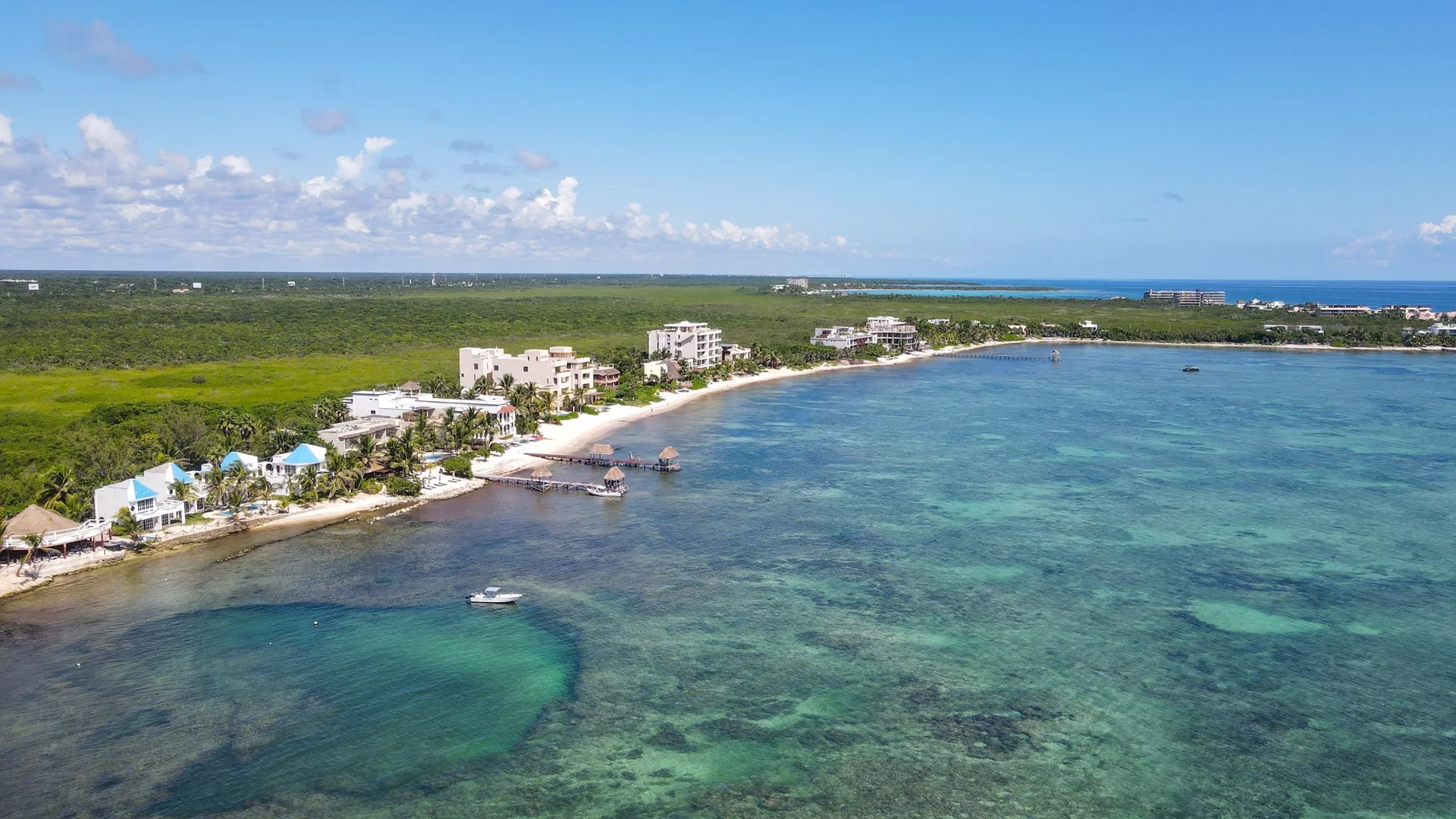
Tankah and Bahía Solimán
About 10 minutes north of Tulum lie the only genuine residential beachfront bays: calm, reef-protected waters, cenotes and legally protected low density. This is «Tulum for grown-ups»: bespoke villas instead of condo towers. There's no publishable price per m² because the market is per-unit and made-to-measure — and that very scarcity is what sustains value. See the inventory on our Tankah and Bahía Solimán landing and the deep dive in Bahía Solimán: the Caribbean's best-kept secret.
How does the Jaguar Park affect beachfront property?
In 2023-2024 the federal government created the Jaguar Park (Jaguar Flora and Fauna Protection Area) over Tulum's beach zone and ruins. This changed the rules of the beachfront:
- Access and fees: the park charges admission (around MXN 415 for foreigners in 2025) and reorganized access. After backlash, in November 2025 two free public access points opened and President Sheinbaum ordered a review of the park.
- Building and operating restrictions on the hotel strip, which triggered a wave of hotel regularization.
- Real-estate effect: more scarcity and more regulatory uncertainty on the federal strip — reinforcing that beachfront is a concession asset, not a titled one, and raising the value of the few properties with solid title behind the federal zone.
Translation for the investor: beachfront in Tulum demands specialized legal advice. The reward is scarcity; the risk is buying a concession without understanding its limits.
Do the airport and the Maya Train really raise property values?
Yes — with caveats almost no brochure mentions. The Felipe Carrillo Puerto International Airport (TQO) opened in December 2023 and in 2025 moved about 1.25 million passengers, with around ten airlines and direct flights from Houston, Miami, Dallas, Atlanta and Newark, plus Canada. It sits about 20 km from town and operates well below capacity — clear room to grow.
The Maya Train has two Tulum stations (town and airport) running since September 2024, with a Cancún–Tulum leg around USD 24. Now the honest part: in its first year the service faced low frequency, operational incidents and ridership far below projections. It's a long-term catalyst and a connectivity argument, not an instant appreciation miracle.
We go deeper into the Maya Train in its effect on property values.
What does a Tulum vacation rental actually net?
Less than developers promise, and a lot depends on the product. Average annual occupancy runs 28.9% (AirROI, Jun 2025-May 2026; Airbnb median, not hotel occupancy) and is highly seasonal. Gross yield splits in two:
- Generic condos: around 5% gross, squeezed by oversupply and the price war.
- Well-run villas: between 8% and 15%; properties above USD 2M are cited at 7% to 12% a year.
Add the costs almost nobody mentions: Quintana Roo's lodging tax is 6% for digital platforms (Airbnb, villas) plus an environmental sanitation fee of MXN 30 per room per night, on top of management, maintenance and commissions. We break down real numbers in Tulum vacation rentals: real ROI, occupancy and costs 2026.
Can a foreigner buy in Tulum? Fideicomiso and the restricted zone
Yes, and it's perfectly safe when done right. All of Tulum sits inside Mexico's restricted zone (the 50 km from any coastline), so no foreigner takes direct title in any zone — not on the beach, not in the jungle. The standard route is the bank trust (fideicomiso): a Mexican bank holds the title in trust for you, with full ownership rights (sell, rent, inherit, remodel).
- Term: 50 years, renewable indefinitely.
- Cost: setup of ~USD 2,000–3,000 and an annual fee of ~USD 550–1,000.
- Alternative: a Mexican corporation, common for commercial use or multiple properties.
The full step-by-step — and how to avoid the costly mistakes — is in our fideicomiso guide.
Tulum, Playa del Carmen or Cancún? How to choose
If you're torn between the Riviera Maya's three big markets, here's the short rule:
- Cancún — the most liquid and stable market, with an established international airport and year-round rental demand. Lower risk, more moderate appreciation. See properties in Cancún.
- Playa del Carmen — the balance: a mature city, solid rentals and consolidated premium enclaves like Playacar and Corasol. See properties in Playa del Carmen.
- Tulum — the highest potential and the highest risk: the correction created opportunities in the right segment, but it demands selectivity. It's for the buyer who enters on value, not on hype.
The full side-by-side analysis of all three markets is in our guide to investing in the Riviera Maya 2026.
5 mistakes to avoid when investing in Tulum
- Buying the oversupplied generic condo at a «bargain» price: if hundreds just like it exist, your rental and your resale compete against all of them.
- Believing occupancy projections of 80% or more: reality is around 28.9% a year (AirROI, Jun 2025-May 2026; Airbnb median). Always model with conservative numbers.
- Paying for beachfront without understanding the federal concession or the Jaguar Park rules. Demand legal advice before signing.
- Trying ownership shortcuts instead of the fideicomiso: it's mandatory for foreigners and it's exactly what protects your investment.
- Buying pre-sale without vetting the developer and their delivery track record. Compare pre-sale vs ready-to-move and read about the mistakes foreigners make buying in the Riviera Maya.
Which Tulum zone should you invest in, by profile?
Bluntly, here's what we recommend by goal:
- You want to preserve capital and sleep at night: genuine beachfront with solid title or a villa in Tankah / Bahía Solimán. It's the segment that resisted the correction.
- You're after 5-10 year appreciation and tolerate infrastructure risk: Region 15, with services due diligence.
- You want lifestyle and an accessible entry: La Veleta, choosing the street carefully.
- You need liquidity and turnkey services: Aldea Zama, while dodging the oversupplied generic condo.
At Nautilus we work mostly in the segment the correction rewarded: branded residences and beachfront property — from Azulik and Faena to the villas of Acalai and the bays of Tankah. If you'd like, we'll build a comparison tailored to your budget and goal — no pressure.
Keep reading about Tulum and the Riviera Maya
- Properties in Tankah and Bahía Solimán — the beachfront inventory.
- Bahía Solimán 2026: the Caribbean's best-kept secret.
- Tulum vacation rentals: real ROI, occupancy and costs.
- Fideicomiso: how a foreigner buys in Mexico.
- Guide to investing in the Riviera Maya 2026.
Looking to invest in the Riviera Maya?
Personalized advice, zero pressure — branded residences and luxury properties.
WhatsApp Contact